An established
global technology
Offshore wind is one of the fastest growing energy technologies worldwide.
The first offshore wind farm was constructed in Denmark in 1991.
Since then, the industry has evolved with advancements in design, logistics and maintenance processes.
Just one of today’s modern turbines can produce more energy than the entire project built in 1991.
Offshore wind early adopters, like the UK and Denmark, now produce more than 10% of their electricity needs from offshore wind.
Advanced economies across the globe use offshore wind as part of a balanced energy grid to boost energy security and cut carbon emissions.
Offshore wind
in Australia
Australia’s extensive untapped offshore wind resources will contribute to energy security, emissions reduction and the economy.
Offshore wind energy is a new industry for Australia with enormous potential.
In recognition of this potential, the Australian Government has established a regulatory framework for offshore wind, the Offshore Electricity Infrastructure Act 2021, under which it has:
- Declared six priority areas for offshore wind around the country
- Invited applications from developers wishing to assess the feasibility of project proposals
- Offered Feasibility Licences to developers with credible proposals
- Established the Offshore Infrastructure Regulator to regulate the industry.
Offshore wind will play a critical role in Victoria’s energy future. With over 4 GW of Latrobe Valley coal capacity retiring over the coming decades, the Victorian Government has:
- Legislated offshore wind energy targets of 2 GW by 2032, 4 GW by 2035 and 9 GW by 2040
- Starting planning port and transmission infrastructure for offshore wind energy.
Gippsland is leading the country
This region has the best offshore wind fundamentals in Australia. In fact, it’s one of the best places in the world to harness the power of offshore wind.
Here’s why:
- Strong and consistent Bass Strait winds
- Shallow seabed suitable for proven turbine foundations
- Proximity to a strong grid connection point
- A skilled energy workforce and supply chain
- Proximity to existing commercial ports
- Broad community support.
The Latrobe Valley in Gippsland has powered Victoria for a century with four major coal power stations. One closed in 2017 with two more retirements planned in 2028 and 2035. Energy is an important industry for the region and this can continue into the future with offshore wind.
How it works
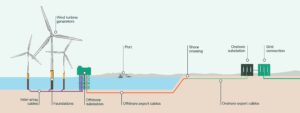
Offshore wind farms are like power stations at sea.
Large turbines far off the coast catch strong ocean winds, generating large amounts of electricity very reliably.
Electricity from the turbines is transported to the grid through a transmission system of cables and substations.
Here are the parts that make up an offshore wind farm: